Pages

  • Blockquote

    Mauris eu wisi. Ut ante ui, aliquet neccon non, accumsan sit amet, lectus. Mauris et mauris duis sed assa id mauris.

  • Duis non justo nec auge

    Mauris eu wisi. Ut ante ui, aliquet neccon non, accumsan sit amet, lectus. Mauris et mauris duis sed assa id mauris.

  • Vicaris Vacanti Vestibulum

    Mauris eu wisi. Ut ante ui, aliquet neccon non, accumsan sit amet, lectus. Mauris et mauris duis sed assa id mauris.

  • Vicaris Vacanti Vestibulum

    Mauris eu wisi. Ut ante ui, aliquet neccon non, accumsan sit amet, lectus. Mauris et mauris duis sed assa id mauris.

  • Vicaris Vacanti Vestibulum

    Mauris eu wisi. Ut ante ui, aliquet neccon non, accumsan sit amet, lectus. Mauris et mauris duis sed assa id mauris.

Egypt attack: President Sisi pledges forceful response

Saturday, 25 November 2017 0 comments

The al-Rawda mosque in the town of Bir al-Abed was bombed and fleeing worshippers were then gunned down.
The military has conducted air strikes on targets in nearby mountains, Reuters news agency reports.
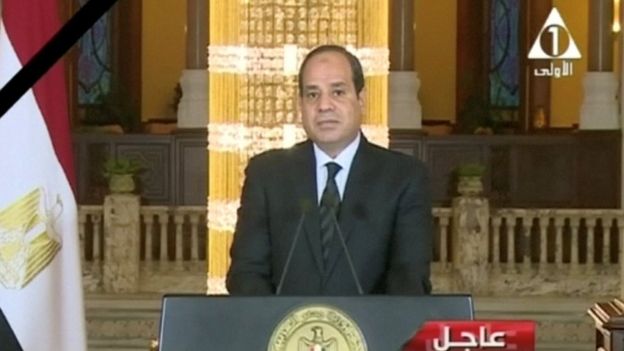
Egyptian President Abdel Fattah Al Sisi gives a televised statement on the attack in North Sinai, in Cairo, Egypt November 24, 2017 in this still taken from video
No group has yet claimed the attack, the deadliest in recent memory.
Egyptian security forces have for years been fighting an Islamist insurgency in the Sinai Peninsula, and militants affiliated with so-called Islamic State (IS) have been behind scores of deadly attacks in the desert region.
They usually target security forces and Christian churches, and the bloody attack on a mosque associated with Sufi Muslims has shocked Egypt.
"What is happening is an attempt to stop us from our efforts in the fight against terrorism," Mr Sisi said in a televised address hours after the attack.
"The armed forces and the police will avenge our martyrs and restore security and stability with the utmost force."
Three days of national mourning have been declared.
Mr Sisi, the former head of Egypt's armed forces, has emphasised national security and stability during his time as president.

What happened?

Dozens of gunmen surrounded the mosque in vehicles and bombed it before opening fire on those trying to escape.
The assailants are reported to have set parked vehicles on fire in the vicinity to block off access to the mosque, and they fired upon ambulances trying to help victims.
At least 100 people were wounded, reports say, overwhelming hospitals.
It is the deadliest militant attack in modern Egyptian history. Bir al-Abed is about 130 miles (211km) from Cairo.

Can Sisi curb a stubborn insurgency?

By Orla Guerin, Cairo correspondent
This is a major challenge to the Egyptian state.
If this was IS, it is always worth considering the broader regional dimension. In the last few months, IS has had massive territorial losses in Iraq and across the border in Syria.
If IS was behind this, this could be an attempt to remind supporters around the world that they are still here, still relevant and can still inflict terrible damage on their enemies.
What we don't know right now is if the Egyptian security establishment, if President Sisi, has anything else in the arsenal to try.
He has already tried the hardline military approach - there has been a massive military operation going on in the Sinai peninsula for years. It has not delivered results that time and time again the Egyptian establishment has promised.
But it is unclear if they have something new they can try to attempt to curb this very stubborn Islamic insurgency which today has inflicted such terrible damage.

Who was targeted?

Locals are quoted as saying that followers of Sufism, a mystical branch of Sunni Islam, regularly gathered at the mosque.
Although Sufis are widely accepted across much of the Muslim world, some jihadist groups, including IS, see them as heretics.
  • Egypt's militant groups explained
  • Sisi the strongman
  • What is Sufism?
The head of IS's religious police in Sinai said last December that Sufis who did not "repent" would be killed, after the group beheaded two elderly men reported to be Sufi clerics.
The victim of the mosque attack also included military conscripts.
The number of victims is unprecedented for an attack of this type, says the BBC's Sally Nabil in Cairo. She adds that this is the first time that worshippers inside a mosque have been targeted by militants in North Sinai.

Who might be behind the attack?

Militant Islamists stepped up attacks in Sinai after Egypt's military overthrew Islamist President Mohammed Morsi following mass anti-government protests in July 2013.
Hundreds of police, soldiers and civilians have been killed since then, mostly in attacks carried out by the Sinai Province group, which is affiliated to IS.
Sinai Province has also carried out deadly attacks against Egypt's Coptic Christian minority elsewhere in the country, and said it was behind the bombing of a Russian plane carrying tourists in Sinai in 2015, killing 224 people on board.
  • Egypt disputes desert shootout reports
  • Sinai plane crash: What we know
  • The IS affiliate in Sinai
It has been operating mainly in North Sinai, which has been under a state of emergency since October 2014, when 33 security personnel were killed in an attack claimed by the group.
Sinai Province is thought to want to take control of the Sinai peninsula in order to turn it into an Islamist province run by IS.
Journalists, including from state-sponsored outlets, have not been allowed to report from North Sinai in the last few years.
Correspondents say that the frequency of attacks raises doubts about the effectiveness of military operations against militants.

What has the reaction been internationally?

Arab League chief Ahmed Aboul Gheit condemned the attack as a "terrifying crime which again shows that Islam is innocent of those who follow extremist terrorist ideology".
Governments in the UK, US, France, Russia, Israel, Iran, Saudi Arabia and elsewhere have deplored the massacre.
[BBC SOOURCES]

Manus Island: Buses of refugees leave former Australian camp

Friday, 24 November 2017 0 comments

Hundreds of detainees refused to leave the Manus Island centre when it shut on 31 October, citing safety fears.
The Australian Broadcasting Corporation (ABC) reported that all had been moved to alternative accommodation on Friday.
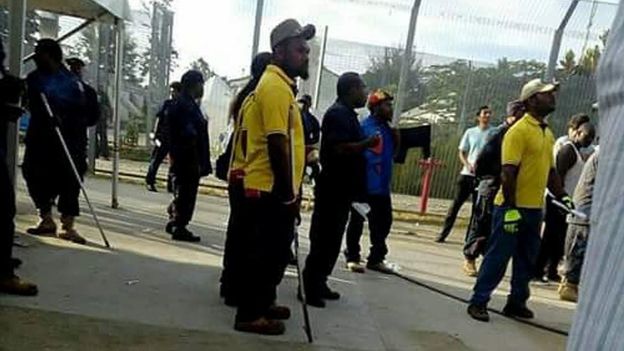
Some men were beaten with batons by PNG police, detainees claimed.
Videos posted on social media showed PNG authorities swinging poles towards asylum seekers.
"They [the asylum seekers] are leaving, all the people. They don't like to move but then they beat us," one refugee told the BBC on Friday.
Earlier, police commissioner Gari Baki had said that removals on Thursday had been conducted "peacefully and without the use of force". Australia has said it is not involved in the operation.
Under a controversial policy, Australia has detained asylum seekers who arrive by boat in camps on Manus Island and Nauru, a small Pacific nation.
Australia shut down the Manus Island centre after a PNG court ruled it was unconstitutional.
The UN said on Thursday it was troubled by reports the men were being forcefully moved but could not independently verify the allegations because its staff had been denied access to the centre.
The men inside had refused to leave the camp over fears they would be attacked. The asylum seekers' presence is a cause of tension on the island.
  • 'Our situation is just like hell'
  • Manus: Timeline of a key events
  • Australia asylum: Why is it controversial?
The former detainees have been transferred to alternative accommodation on the island.
ABC reporter Liam Fox said he had seen at least 12 buses head to the alternative facilities, and that 328 men had been moved on Friday.
PNG police and immigration officials holding poles in the Manus detention centre
Earlier this week, the UN's refugee agency said that the alternative housing remained "under construction", was inadequately secured, and lacked "the most basic services" such as medical care.
Canberra has steadfastly ruled out allowing the men into Australia, arguing it would prompt further human trafficking and lead to deaths at sea.

PNG police enter Manus asylum centre, Australia confirms

Thursday, 23 November 2017 0 comments

Hundreds of men have refused to leave the Manus Island centre since it was shut down on 31 October, citing fears for their safety.
On Thursday, multiple men inside the centre said that PNG police had given them a one-hour deadline to leave.
Australia said it was a PNG operation.
Under a controversial policy, Australia has detained asylum seekers who arrive by boat in camps on Manus Island and Nauru, a small Pacific nation.
Australia shut down the Manus Island centre after a PNG court ruled it was unconstitutional, urging asylum seekers to move to transit centres elsewhere on the island.
  • 'Our situation is just like hell'
  • Manus: Timeline of a key events
  • Australia asylum: Why is it controversial?
Immigration Minister Peter Dutton confirmed a police operation was under way on Thursday.
"The Australian taxpayers have paid about $10 million for a new facility and we want people to move," he told Sydney radio station 2GB.
"Obviously, it is in the end an issue for PNG police and the authorities up there but there is an operation involving police at the centre this morning."
One refugee, Abdul Aziz Adam, said a large amount of police officers had entered the compound.
"They had a really big microphone in their hands and started telling people 'you have to move'," he told the BBC, describing the police action as aggressive.
He said about 420 asylum seekers had gathered in one section of the centre, many of them linking arms, but he insisted they would "not respond" in any way.
The men have spent more than three weeks without electricity and running water, while food supplies have dwindled.
An asylum seekers lies on the ground the closed centre
They have refused to leave because of fears they will be attacked in the local community. Rights groups say that asylum seekers have been attacked in the past.
Australia has repeatedly said that the alternative accommodation is ready.
However, the UN's refugee agency said on Tuesday that housing remained "under construction", was inadequately secured, and lacked "the most basic services" such as a medical care.
"We were there and saw for ourselves that they are trying to complete the site as quickly as possible," said deputy regional representative Nai Jit Lam.
Canberra has steadfastly ruled out allowing the men into Australia, arguing it would prompt further human trafficking and lead to deaths at sea.
[BBC SOURCES]

Meera: The actress in a legal row to prove she's unmarried

Wednesday, 22 November 2017 0 comments

Irtiza Rubab, who is known by her stage name Meera, has acted in commercially successful films, and won local awards for her work.
Now, she's making headlines for another reason - because of a court battle against a man who alleges he's her husband.

Who is Meera?

She's considered a well-known actress in Lollywood - that is, Pakistani's film industry in Lahore.
In addition to local films, the 40-year-old has also starred in Bollywood films and has previously expressed a desire to get involved in politics.
She is also known for her social media videos, and for her presentation style, which many find entertaining.
Pakistani actress Meera dances during the 46th Nigar Public Film Awards ceremony in Lahore, early 03 April 2004
Pakistanis like teasing her about her accented English - something she tends to take sportingly - and a recent video of her singing the Titanic theme song, My Heart Will Go On, went viral, delighting and horrifying many.

How did she get embroiled in the controversy?

In 2009, Ateeq-ur-Rehman a businessman from Faisalabad, told journalists he had married Meera in a private ceremony in 2007.
He said he was unhappy Meera hadn't acknowledged him publicly as her husband, and was still telling her fans she was single.
He even produced a marriage certificate as "proof" of their marriage, and said he had filed several court petitions against Meera.
In the applications, he argued she should be medically examined to prove she is his wife, that she should not marry anyone else before divorcing him, that he should have possession of a house where she is living, and that she should be restrained from going abroad.
Speaking to the BBC, Meera's lawyer Balakh Sher Khosa said that a medical application seeking a "virginity test" for Meera had been filed by Mr Rehman, who claimed that the actress is not a virgin and that she was lying about being single.
"This particular application was later dismissed by the Lahore High Court. In Pakistan, such medical applications allow the virginity tests of women in rape and adultery cases where the woman has to establish that she has lost her virginity as a result of the committed crime.
"But in cases similar to that of Meera, calling someone their wife or husband, the virginity test can only be allowed with the consent of the involved woman. Ateeq's claim was baseless - that's why the court dismissed it."
Meera has denied all of Mr Rehman's claims, and insisted she is not married to anyone. She also filed a countersuit in 2010, challenging the marriage certificate.

Who should we believe?

The case made headlines across Pakistan when it first emerged. And public opinion is divided.
Meera has dismissed Mr Rehman as "disturbed and hungry for fame".
She told the BBC Mr Rehman was a promoter who she had met through a friend, and worked with on a few concerts and tours.
"One day out of nowhere he presented some fake photographs claiming that we are married... How can he be allowed to call me his wife?"
She argues that she would never have such a low-profile marriage in any case. "I am a celebrity, would I ever get married in a room so simply?"
Meanwhile, Mr Rehman's lawyer, Ali Bokhari, told the BBC: "He has married Meera in the presence of her mother and uncle. Meera should accept that she is Ateeq's wife."

Do people really go to court to prove they're 'married' to someone?

Yes - this has happened several times at family courts in Pakistan - although this is the first case involving a celebrity.
Typically, the cases have involved a man filing a court case, arguing that his alleged spouse should not be allowed to marry someone else.
Some men have produced fake marriage certificates in the past - in those cases, the woman can normally win the case after proving that there was never a marriage registered with the local council. But it can be a lengthy process.
Meera's case, which has lasted seven years, has brought attention to how slow Pakistan's family courts can be.
She has argued that the claims have hurt her reputation, and made it difficult for her to get married until the case is resolved.
"I want to get married and have children, time is running out. Indeed my work and mental well-being is affected by all this but I continue to work and travel, thankfully there are no restrictions on that," she said.

What happens now?

The marriage row has rumbled on for seven years - but may finally be reaching a conclusion.
Meera's lawyer accuses Ateeq-ur-Rehman of delaying tactics to prolong the case.
"Ateeq's lawyer has been changed so many times that I have lost count now. They hardly ever come to the court when the case is heard," Balakh Sher Khosa told the BBC.
"Of course there are some other minor hurdles also, like transfer and absentia of related judge. I am the third lawyer for Meera but the delay has never been from our side as Meera has already recorded her statement back in 2011."
Last week, a family court within the civil courts in Lahore finally dismissed Mr Rehman's application that Meera be prevented from marrying anyone else without a divorce.
Even that did not bring matters to a close, however.
Judge Babar Nadeem said the court had not yet decided whether the marriage certificate was genuine or fabricated - but that under the Family Court Act 1964, Meera could not be restrained from marrying anyone.
However, he added that if Mr Rehman is later able to prove that he and Meera are married, the actress will be responsible for any legal consequences.
Meera is still considering this a victory, saying: "Justice has finally been served."
Judge Nadeem has instructed both counsels to finish their arguments as soon as possible, and says a final court decision will be given before 30 December 2017.
[BBC SOURCES]

Zimbabwe latest: Mugabe 'let wife Grace usurp power'

Tuesday, 21 November 2017 0 comments

The motion is now due to be presented to parliament on Tuesday.
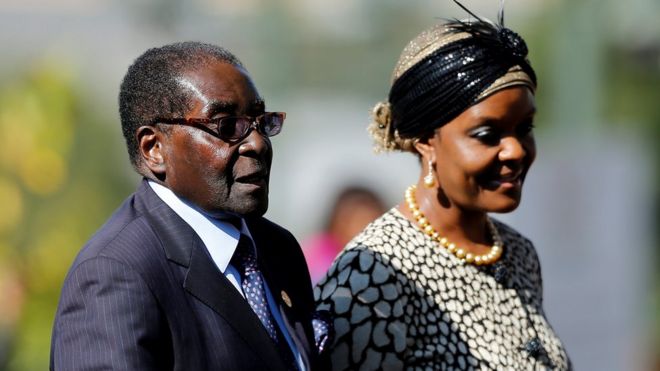
Zimbabwean President Robert Mugabe (L) with his wife Grace in a file photo taken in South Africa in 2014
Senior party member Paul Mangwana said the process could take as little as two days to complete, and President Mugabe could be removed by Wednesday.
A deadline set by Zanu-PF for his resignation passed on Monday.
Separately, military leaders said they had planned a "roadmap" for Mr Mugabe's future, and that the ousted former vice-president, Emmerson Mnangagwa, would return to the country soon.
Grace Mugabe and Mr Mnangagwa had both been seen as potential successors to the ageing president. But earlier this month, Mr Mugabe fired his deputy - widely seen as an endorsement of his wife - prompting a military intervention.
The country's top general said Mr Mugabe and his former deputy had been in contact, and would hold in-person talks soon.

What are the charges against President Mugabe?

Zimbabwe's constitution allows for impeachment on grounds of "serious misconduct", "violation" of the constitution or "failure to obey, uphold or defend" it, or "incapacity".
"The main charge is that he has allowed his wife to usurp constitutional power when she has no right to run government. But she is insulting civil servants, the vice president, at public rallies. They are denigrating the army - those are the charges," Paul Mangwana said, emerging from a party meeting.
"He has refused to implement the constitution of Zimbabwe - particularly we had elections for the provincial councils, but up to now they have not been put into office.
"He is of advanced age, that he no longer has the physical capacity to run government," he added.
"He is a stubborn man, he can hear the voices of the people, but is refusing to listen."
  • Monday's developments as they happened
  • Grace Mugabe: Zimbabwe's polarising first lady

What happens next?

Impeachment proceedings are now expected to be launched on Tuesday, with votes in both the National Assembly and the Senate.
Both chambers must then appoint a joint committee to investigate removing the president.
If the committee recommends impeachment, the president can then be removed if both houses back it with two-thirds majorities.
"We are expecting the motion to be moved tomorrow... and hopefully by Wednesday - because the charges are so clear - we expect that by Wednesday, we should be able to vote in parliament," Mr Mangwana said.
The opposition MDC-T party has tried unsuccessfully to impeach Mr Mugabe in the past. But with the support of Mr Mugabe's own Zanu-PF party, which has an overwhelming majority in both houses, the vote is now likely to go against him.
If the impeachment goes ahead, the military can claim that he was removed legally, and not by armed force. If that happens, current vice-president Phelekezela Mphoko should assume the role.
But Mr Mphoko is a known supporter of Grace Mugabe, and the generals would prefer to install Emmerson Mnangagwa, the former vice-president who was named the new Zanu-PF party chief on Sunday.
The crisis began two weeks ago when the 93-year-old leader sacked Mr Mnangagwa, angering army commanders who saw it as an attempt to position his wife as the next president.
With Zimbabwe embroiled in a deep economic crisis, the president had already seen some of his support wane.
Last week, soldiers seized control of the state broadcaster and placed the president under house arrest - but denied their actions amounted to a military coup.
Since then, he has been held at his "blue roof" mansion near the capital.
On Sunday, Mr Mugabe gave a televised address which surprised many Zimbabweans because it made no mention of the pressure from his party and the public to quit.
Surrounded by generals, he declared that the military had done nothing wrong by seizing power and placing him under house arrest.
He then vowed to preside over the Zanu-PF party congress, due in a few weeks.
  • Zimbabwe in 10 numbers
  • The army chief who took power from Mugabe
  • Robert Mugabe - hero or villain?
  • Five things about Zimbabwe crisis
The BBC's Africa editor, Fergal Keane, said his understanding of the situation was that Mr Mugabe had agreed to resign, but then changed his mind.
Mr Mugabe is now opposed by his own party as well as the political opposition, the military and the powerful War Veterans Association.
The public has also poured on to the streets in protest, calling for the end of Mr Mugabe's 37-year presidency.
[BBC SOURCES]

 
knewstoday © 2011 | Designed by RumahDijual, in collaboration with Online Casino, Uncharted 3 and MW3 Forum